 by Amr Mohamed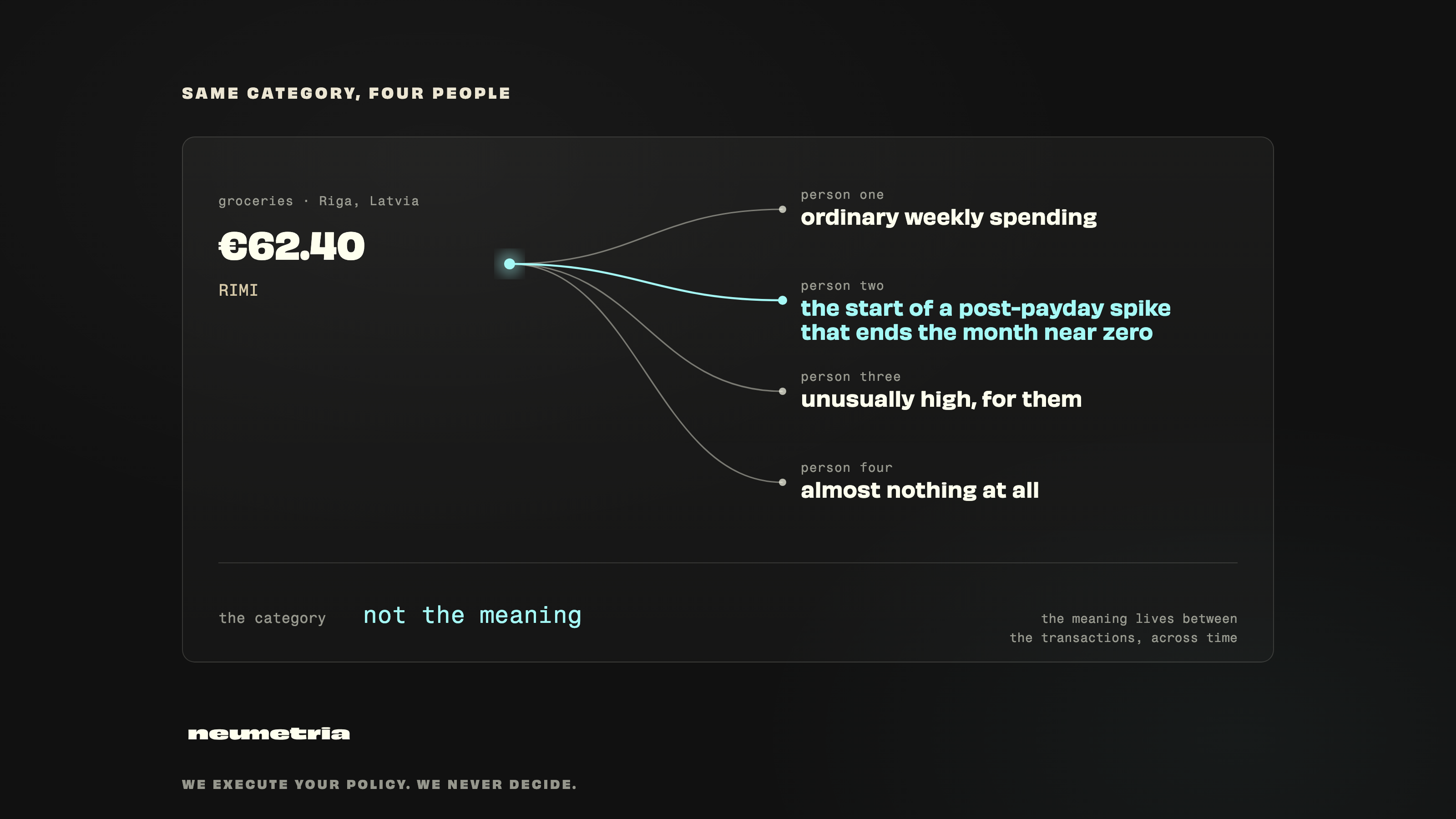
A transaction arrives:
€62.40 — RIMI
A financial data system can do a lot with it.
It can identify the merchant. Resolve the location. Classify it as groceries. Determine whether it is recurring. Compare it with previous purchases. Feed it into a model alongside thousands of other transactions.
All of that is useful.
None of it tells you what the transaction means. For one person, €62 at a supermarket is ordinary weekly spending. For another, it is the beginning of a post-payday spending spike that repeatedly leaves their balance close to zero before the end of the month. For someone else, it is unusually high spending relative to their normal behavior. And for another person, it means almost nothing at all. Same category. Different person. Different meaning.
That distinction matters much more now that financial AI is beginning to act.
We got very good at describing transactions
The financial data stack has improved enormously. Raw bank descriptions that once looked like:
POS 240928 RIMI LATVIJA 1047 RIGA LVcan now become something much more useful:
Rimi · Groceries · Riga, Latvia · €62.40
Merchant enrichment and categorization solved a real problem. Financial applications needed clean, structured information rather than strings from banking systems.
The industry is now moving further. Models can recognize income, recurring payments, subscriptions and unusual activity. They can reason across transaction sequences. They can detect changes in cash flow and predict future events.
This is progress
But there is an important boundary between describing financial activity and understanding the person generating it.
Behavior doesn't live in a transaction
- There is no transaction called financial pressure.
- There is no merchant category for lifestyle creep.
A bank statement does not contain a row saying:
Liquidity is becoming tighter even though income hasn't fallen.
These things emerge across events.
Imagine someone receives €4,000 every month.Looking at the income transaction, their financial position appears stable. Now add another observation: their balance is close to empty for most of the month.
Add another
Discretionary spending consistently accelerates during the days immediately after they are paid.
Add another
Recurring obligations have increased over six months.
Add another
The amount of income they retain each month has been declining.
No individual transaction contains the conclusion. The pattern exists between the transactions and across time. That is the difference between recording financial activity and modeling financial behavior.
And even behavior is not the whole person
There is another problem. Financial lives no longer exist inside one current account. Someone can have €300 in their bank account and €40,000 in a brokerage account.
They can receive a salary into one bank, pay bills from another, hold investments with a broker, carry a credit balance elsewhere and hold crypto in a wallet. Looking only at the bank account can make them appear financially constrained. Looking only at the brokerage account can make them appear highly liquid. Both observations can be technically correct and still produce the wrong understanding of the person.
The unit of analysis matters
The account is not the person. Neither is the transaction.
Understanding financial state means reasoning across how someone earns, spends, saves, borrows, invests, trades and holds assets, and understanding how those behaviors change over time. That is a fundamentally different abstraction.
This matters because AI is moving from answering to acting
When AI was primarily answering questions, getting this distinction wrong had limited consequences.
Ask:
"How much did I spend on restaurants last month?"
Categorization is probably enough.
Ask:
"Can I afford to invest €500 today?"
It isn't.
The answer may depend on salary timing, upcoming obligations, liquidity, income stability, existing investments, recent behavioral changes and what normally happens to this person's finances between now and their next income event.
And we're moving toward an environment where the AI may not simply answer that question. It may be able to act. Financial agents are gaining access to payments, transfers, investments, cards and other financial tools. That changes the infrastructure they need.
Knowing what happened is not enough.
Predicting what might happen is not enough.
Even understanding the person's state is not enough.
Before an agent acts, a financial institution may need to determine whether that action is appropriate under its own policy.
That creates a different stack:
Financial activity → Understanding of the person → Policy → Action
The model can propose. The institution still needs to control.
Capability is not permission
This distinction becomes important as agents become more capable. An agent may be perfectly capable of moving €500. That doesn't mean it should. The relevant questions become:
- What state is this person in?
- How confident are we?
- What evidence supports that conclusion?
- What has changed?
- What does the institution's policy permit in this state?
The result might be:
Act.
Or:
Ask. Wait. Refer for review.
Sometimes the correct result may simply be:
We don't know enough.
That last outcome is particularly important. A system that understands uncertainty is different from one that is merely capable of generating an answer.
The next financial primitive may be the person
For years, financial infrastructure has been organized around objects. Accounts. Transactions. Merchants. Balances. Cards. Securities. Those objects aren't going away. They are the foundation of the system. But agents introduce a new requirement.
If software is going to increasingly act on behalf of people, it needs a representation not only of their financial objects but of the person those objects belong to. A continuously updated financial state.
Not a personality label.
Not a credit score.
Not another category.
A representation of what appears to be true now, what changed, how much evidence supports it and how confidently the system can say it. That state can then be used by a lender, bank, broker, wallet or financial agent according to its own rules.
This is the layer we are building at Neumetria
Not another interface to financial data. Not another chatbot. A state and policy layer between financial activity and the systems increasingly being trusted to act on it. Because categorization can tell an agent that someone spent €62 at a supermarket.
Understanding tells it whether that €62 means anything at all.