
The financial state,
in depth.
Everything Neumetria reads rolls up to one state per person, built from named measures. What it holds, how it stays current as behavior changes, and the readiness gates beside it.
Many accounts in.
One person out.
A person’s financial life is spread across banks, cards, investments, crypto, and event contracts. Neumetria reads the activity your product already receives from all of it: how someone earns, spends, saves, borrows, invests, and holds. From that it builds one picture of the person. That picture is the financial state, and your product and agents query it on demand.
Income Rhythm. How regular and steady the money coming in is.
Spending Confidence. How optional spending changes when money gets tight.
Recovery Velocity. How fast the buffer rebuilds after a hit.
Borrowing Readiness. Room to repay, with the evidence and uncertainty shown.
Allocation Conviction. Whether contributions continue when markets move.
Holding Posture. How concentrated positions are, and what a swing does.

One current view
of every person.
Neumetria gives your product and agents what reasoning alone can’t produce: a current, contextual view of the specific person. Understanding someone takes three kinds of context, and Neumetria reads all three. Culture, the person, and time.
Same behavior, different meaning. A cash-heavy month reads as tight budgeting in one market and normal spending in another. Neumetria factors that context into the read, not a single global average.
Identical transactions, different intent. Two people with the same statement can have different capacity, and very different next moves. Each financial state stands on its own, not as part of a segment.
June is not January. People pick up new patterns and drop old ones. Neumetria keeps following, so the view always describes the person as they are today.
Updated with
every transaction.
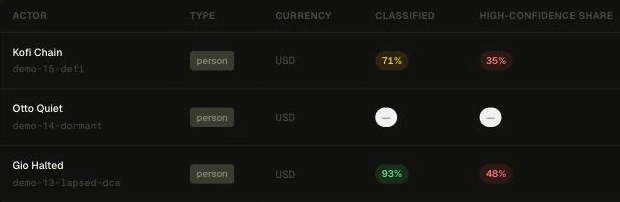
Neumetria re-reads the picture as new activity lands, so when your product asks about a person, the answer describes this month. The view stays as current as the stream feeding it.
- ✓ Show what changed
- ✓ Keep a current financial state
- ✓ Combine linked accounts into one actor view
- ✓ Read that person in their own context
- ✓ Update as new activity comes in

Behavior is a
trajectory.
A single reading tells you where someone is. Months of readings tell you which way they are moving. Neumetria keeps the history, so your product sees resilience building or spending drifting well before a lagging metric does.


One answer,
built from named parts.
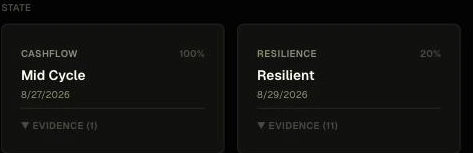
Everything rolls up to one financial state: the answer to what this person’s situation is right now. It arrives with the named measures it was built from, so your product and agents can read the summary or the reasoning underneath.

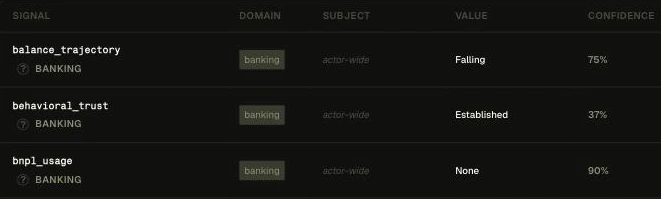
The state,
then the gates.
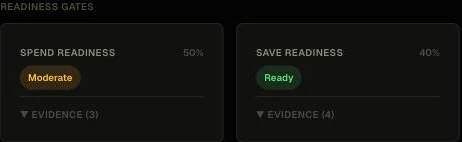
Understanding answers who this person is right now. Gates answer whether this is a moment for a kind of action: spend, save, invest, or stay quiet. A band describes the person, never a verdict on anything you offer and never an answer about one specific act; your product reads it before it acts.
Whether there is genuine room for a spend-facing action right now, without treating every balance as room to act.
Whether a savings or buffer prompt fits the current load, or would add pressure the person cannot take.
Whether a funding or allocation action matches how the person is holding today and the room they actually have.
When behavior is shifting or money is tight, the right action is none. Gates make “not now” a first-class answer.
One word,
two measurements.
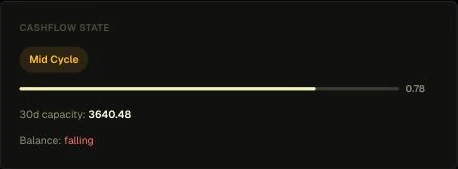
Capacity is always a projection for a question, never one number carried around. A credit question asks whether this person can carry this schedule. An action asks how much room is uncommitted over the weeks ahead. Same lived activity underneath, two different measurements, and every stored answer names the one it used.
The projection behind a credit assessment: how income arrives, what is already committed, what they already service, and what a shock would do. Read from lived activity, beside the bureau, with the evidence attached. Lend reads this one.
The projection an action rule tests: the room left over the weeks ahead once obligations are met, without counting income that has not arrived. Measured at the moment the agent asks, returned on the assessment, stored with it, and resolved into the ceilings your own rules name. Actions reads this one.
Both carry their spec version on every stored answer, so an assessment from March is read under the projection that produced it, not under whatever is current when someone asks.
Read it before you act.
If you are building fintech products or financial agents on a current financial state, talk to us, or build against the sandbox first.