Notes

Writing on behavioral understanding, financial products, and the systems that read them.

September 14, 2026

Neumetria partners with SaaScada

Neumetria is partnering with SaaScada to put real-time transaction data and real-time behavioural understanding on the same rail — giving banks a live, evidence-based read on customer financial health, not another dashboard.

  • partnership
  • Neumetria
  • SaaScada
Read more →
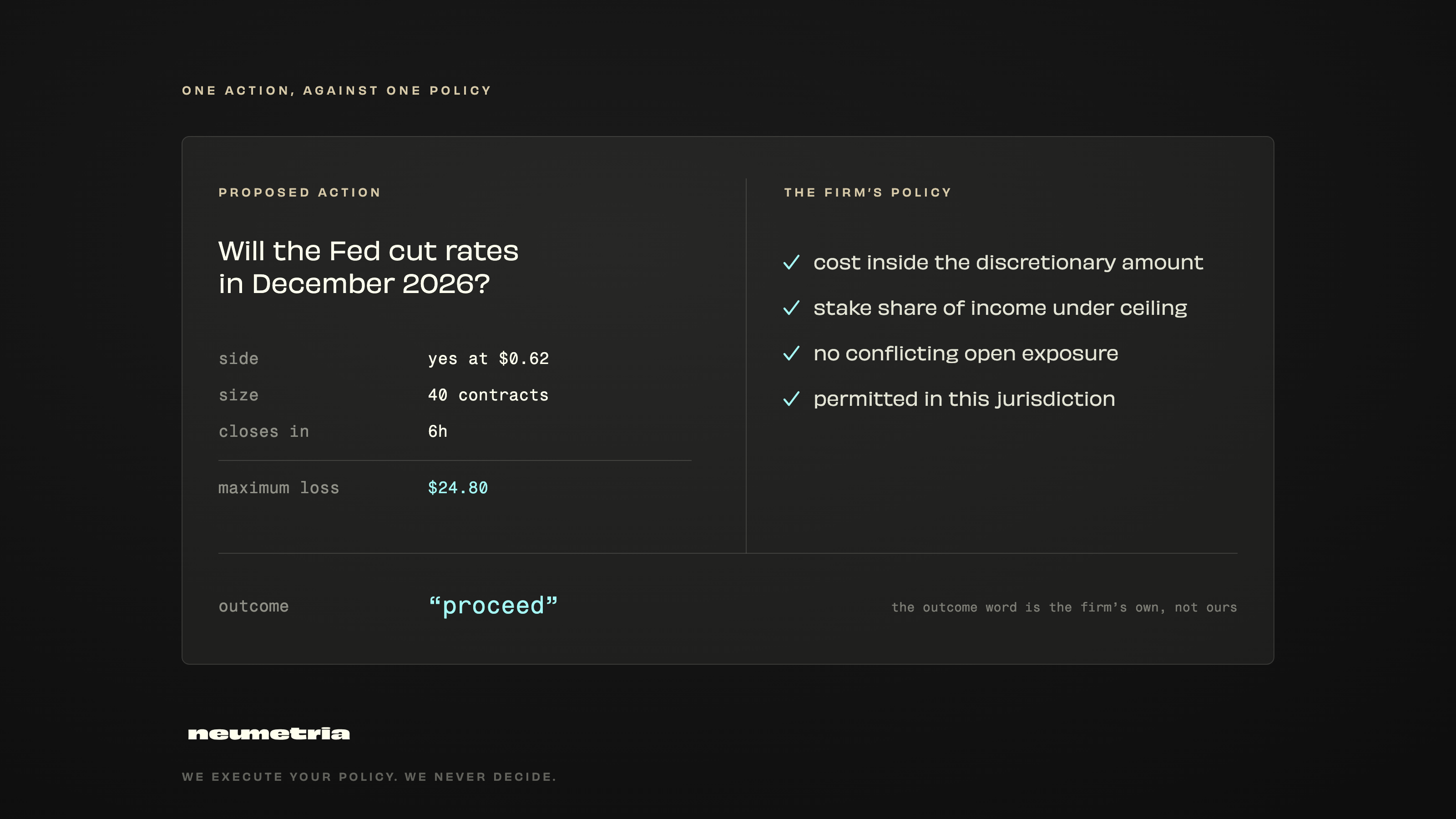
A dark panel split in two. On the left, under the heading “proposed action”, an event contract asking whether the Fed will cut rates in December 2026, with the side taken at 62 cents, a size of 40 contracts, six hours until it closes, and a maximum loss of $24.80. On the right, under “the firm’s policy”, four rules are listed and ticked: cost inside the discretionary amount, stake share of income under ceiling, no conflicting open exposure, permitted in this jurisdiction. Below both, an outcome row reads “proceed”, annotated that the outcome word is the firm’s own, not Neumetria’s.
September 11, 2026

Prediction markets were built for agents. Forecasting is only half the problem.

Event contracts are API-first, binary and dated, which makes them the first retail market an agent can trade end to end. The failure mode is not a bad forecast. It is the position placed after a loss resolves, and it is invisible from inside the order flow.

  • prediction markets
  • event contracts
  • AI agents
Read more →
September 10, 2026

Neumetria is ISO 27001 certified

Neumetria has been certified to ISO/IEC 27001. Scope: the Neumetria platform and its production cloud infrastructure.

  • ISO27001
  • Information Security
  • Data Security
Read more →
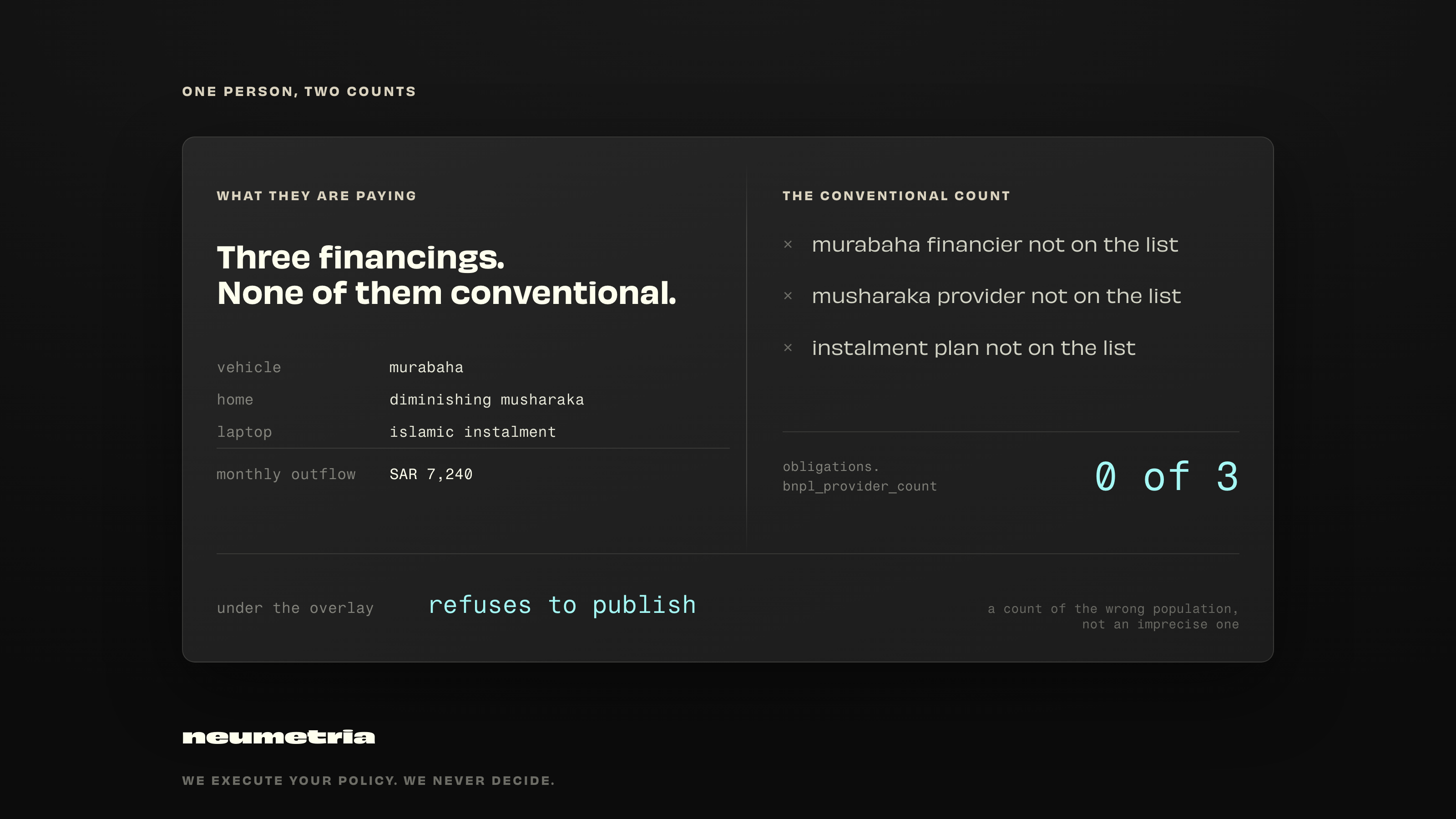
A dark two-column panel. On the left, under the heading "what they are paying", a headline reads "Three financings. None of them conventional.", above rows listing a vehicle financed by murabaha, a home by diminishing musharaka, and a laptop on an Islamic instalment, with a monthly outflow of SAR 7,240. On the right, under "the conventional count", three crossed-out lines note that the murabaha financier, the musharaka provider and the instalment plan are each absent from the provider list, and the fact obligations.bnpl_provider_count returns 0 of 3. An outcome row below reads "under the overlay: refuses to publish", annotated "a count of the wrong population, not an imprecise one".
August 27, 2026

Which law does your policy answer to?

A credit policy declares the legal system it answers to, and the consumer document follows, in the right form and language, including Arabic. The harder half is Islamic finance, where a murabaha instalment and an interest-bearing one arrive as the same row.

  • credit policy
  • islamic finance
  • regulation
Read more →
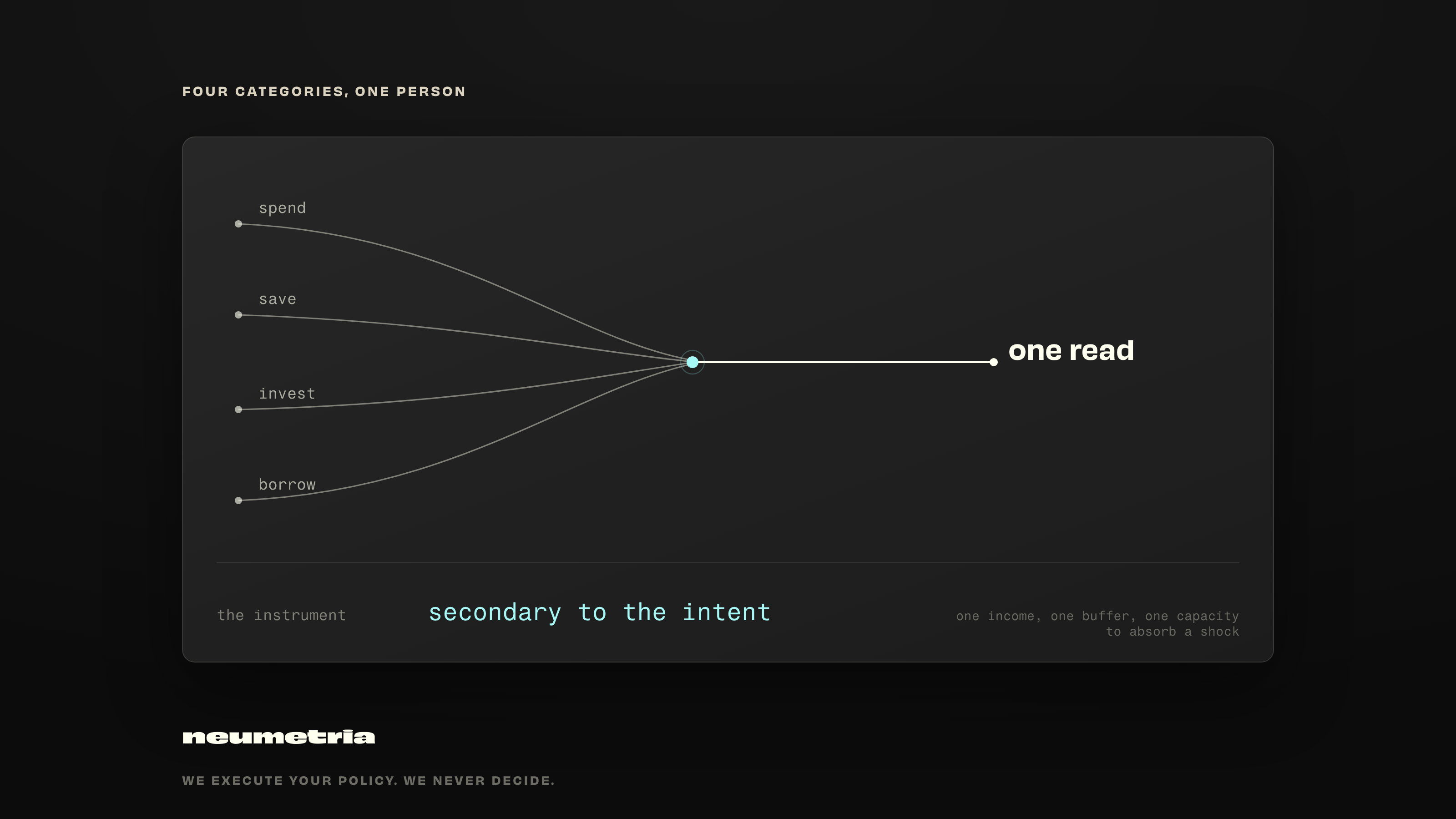
A dark panel headed "four categories, one person". Four labelled streams, spend, save, invest and borrow, curve inward from the left and converge on a single highlighted point, from which one heavier line continues right to a label reading "one read". Below, an outcome row reads "the instrument: secondary to the intent", annotated "one income, one buffer, one capacity to absorb a shock".
August 22, 2026

Financial products are organized around instruments. People aren't.

Category-first infrastructure fragments one user into a banking profile, an investing profile and a crypto profile. It loses what they had in common. The instrument is secondary to the intent, and most infrastructure has it backwards.

  • product
  • architecture
  • behavioral data
Read more →
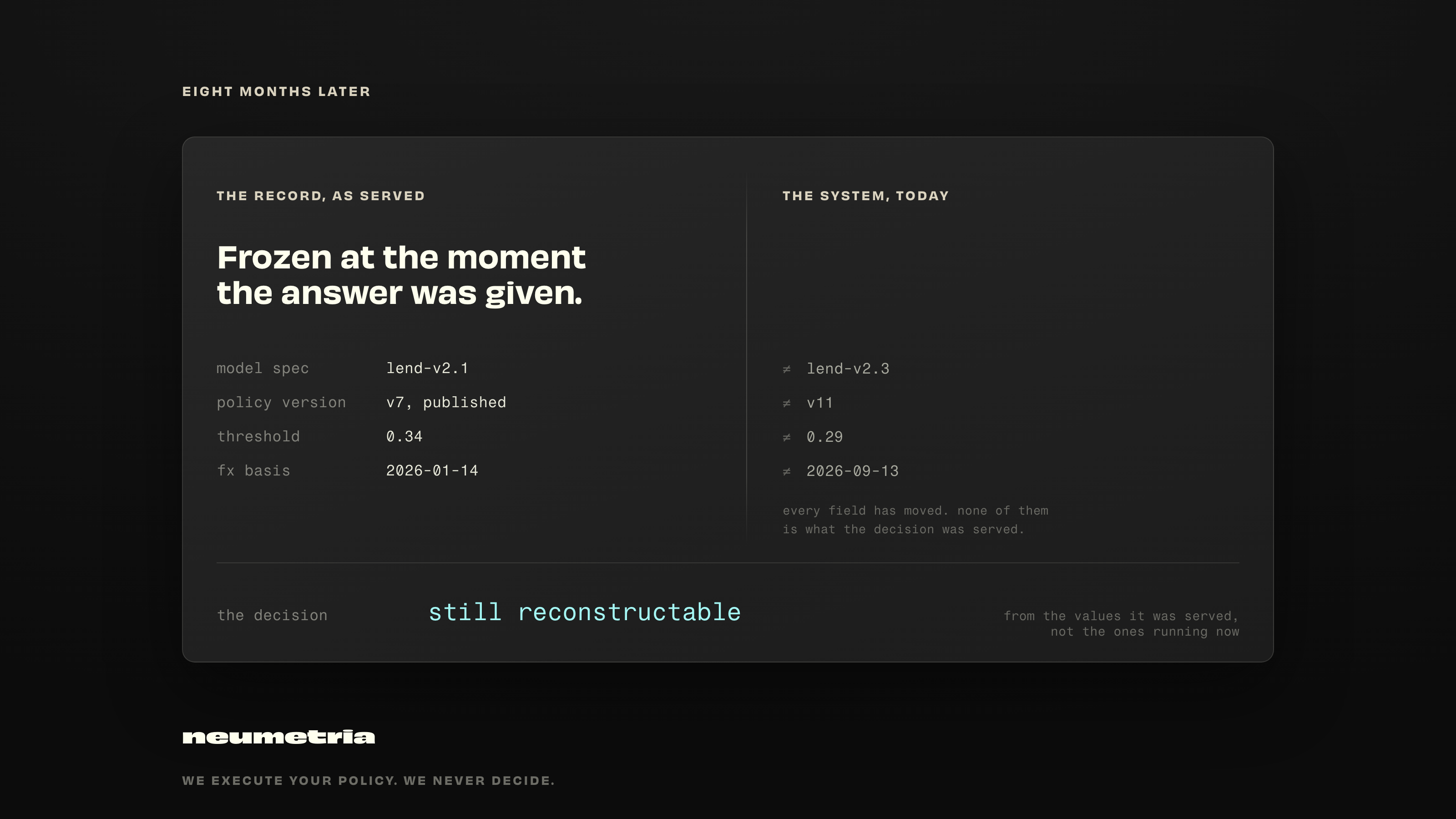
A dark two-column panel under the heading "eight months later". On the left, under "the record, as served", a headline reads "Frozen at the moment the answer was given.", above four values: model spec lend-v2.1, policy version v7 published, threshold 0.34, FX basis 2026-01-14. On the right, under "the system, today", each value is marked as not equal to its counterpart: lend-v2.3, v11, 0.29, 2026-09-13, with a note that every field has moved and none of them is what the decision was served. An outcome row reads "the decision: still reconstructable", annotated "from the values it was served, not the ones running now".
August 22, 2026

Can You Explain a Lending Decision Eight Months Later?

A defensible lending decision today still has to be explainable months later — reconstructed from the model, policy and thresholds that actually applied when it was made, not the ones running now.

  • lending
  • explainability
  • compliance
Read more →
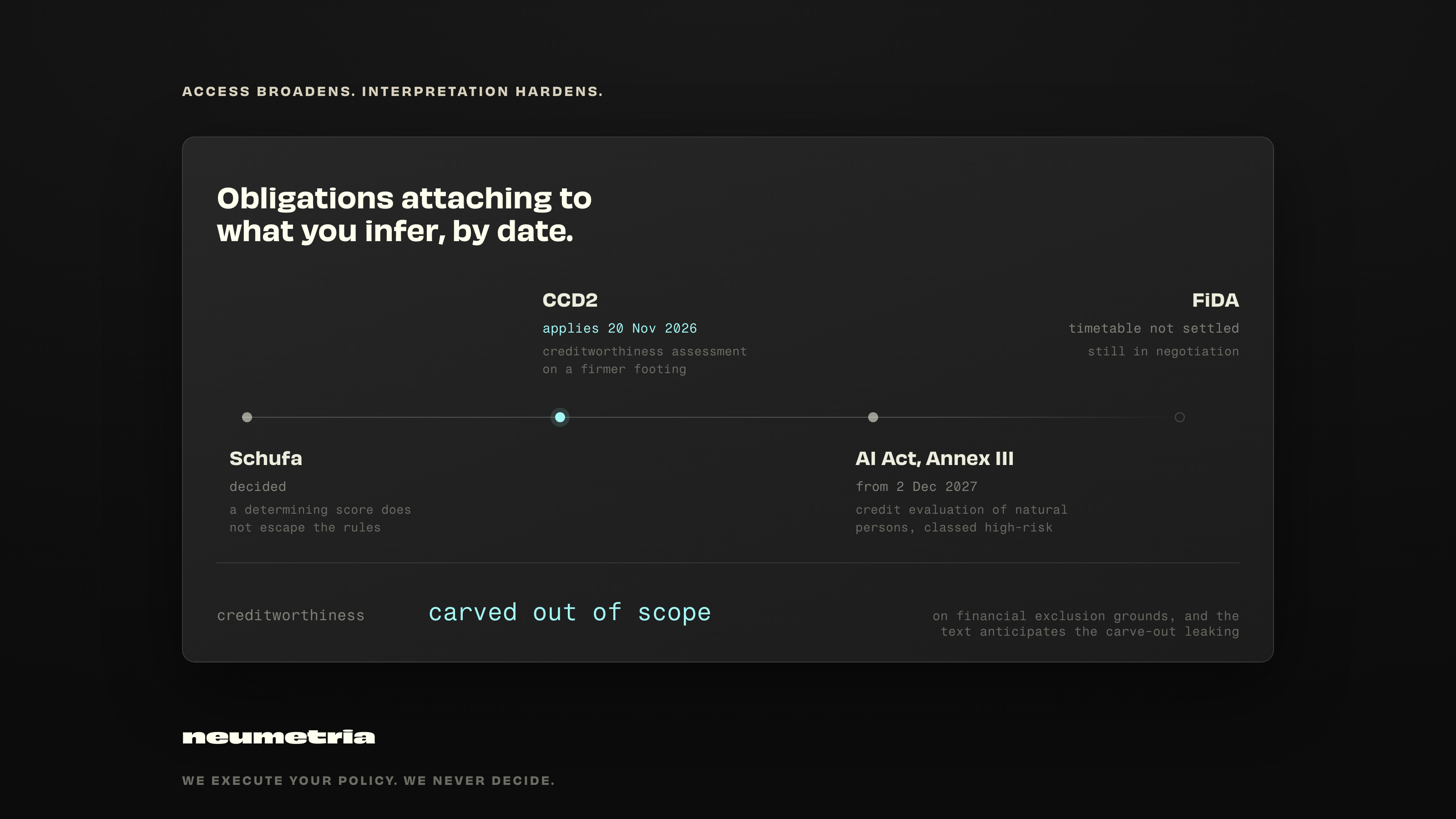
A dark panel headed "Obligations attaching to what you infer, by date." A horizontal timeline carries four markers: Schufa, decided, noting that a determining score does not escape the rules; CCD2, highlighted, applying 20 November 2026, putting creditworthiness assessment on a firmer footing; the AI Act Annex III, from 2 December 2027, classing credit evaluation of natural persons as high-risk; and FiDA, an open marker whose timetable is not settled. Below, an outcome row reads "creditworthiness: carved out of scope", annotated that this is on financial exclusion grounds and that the text anticipates the carve-out leaking.
August 22, 2026

Open Banking Solved Access. The Harder Problem Is One You Cannot Mandate.

Europe's next data regulation carves creditworthiness out of open access, admitting that inference — not access — is now the harder problem. FiDA, CCD2 and the AI Act are converging on judgment just as open banking finishes solving the pipe.

  • open banking
  • FiDA
  • credit risk
Read more →